- Author: Joseph Brook
Political elections have a way of making investors uncomfortable. Campaign rhetoric intensifies, economic policies become political battlegrounds, and financial headlines increasingly focus on what might happen if one party gains or loses control of government. For investors, the temptation is to anticipate the outcome and reposition portfolios before the votes are counted. Yet history suggests that the greatest source of market anxiety may not be who wins an election, but the uncertainty surrounding the result.
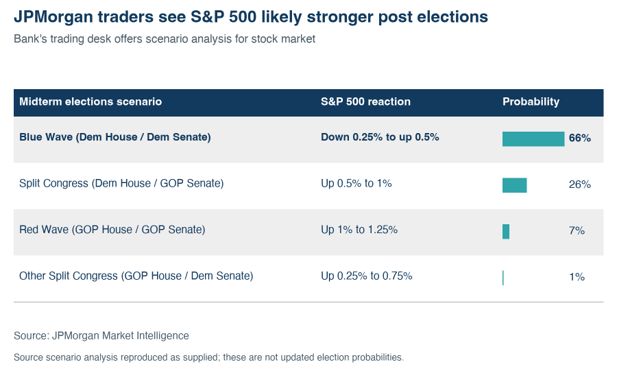
U.S. midterm elections provide a particularly interesting example. While the political consequences can be significant, historical market performance suggests that equities have frequently responded positively once election uncertainty begins to fade. This distinction matters because investment decisions driven by political expectations can introduce unnecessary risk, particularly when those expectations overshadow corporate fundamentals, economic conditions, and long-term financial objectives.
The Political Outcome May Matter Less Than Investors Think
Financial markets constantly evaluate uncertainty. Interest rates, inflation, corporate earnings, employment trends, and geopolitical developments all influence expectations about future economic performance. Elections introduce another variable, particularly when the balance of political power could affect taxation, government spending, regulation, and broader fiscal policy.
However, markets do not necessarily require a particular political outcome to move higher. What they often need is greater clarity about the environment in which businesses and investors will operate. Once an election concludes, investors can assess actual policy priorities rather than react to competing campaign promises and speculative scenarios.
This helps explain why market performance following midterm elections has historically been more favorable than the political headlines might suggest. Removing uncertainty can allow attention to return to corporate profitability, consumer spending, economic growth, and other factors that ultimately influence investment returns.
For long-term investors, the implications matter. Predicting an election result is not the same as developing a sound investment strategy, and correctly anticipating a political outcome does not necessarily translate into correctly predicting the market’s reaction.
Eight Decades of History Offer an Interesting Perspective
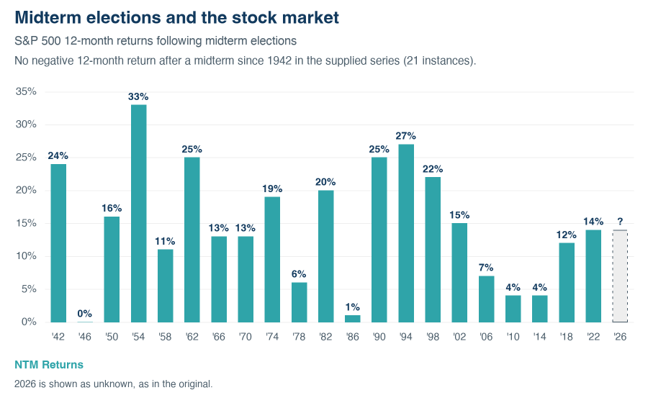
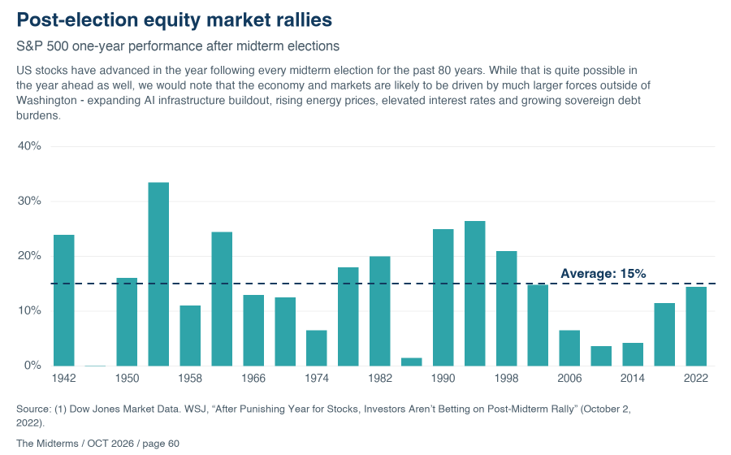
Historical U.S. equity performance following midterm elections presents a compelling pattern. According to the historical analysis referenced in recent market commentary, the S&P 500 has advanced in the 12 months following every midterm election across an approximately 80-year period, with an average gain of roughly 15%.
That observation challenges the assumption that political division or a change in congressional control must necessarily produce negative investment returns. Over multiple election cycles, markets have shown they can move forward under different combinations of presidential leadership and congressional control.
However, historical averages require careful interpretation. A positive 12-month return does not mean markets experienced uninterrupted gains throughout that period. Investors may still have encountered significant volatility, temporary declines, and periods of economic uncertainty along the way. Furthermore, the number of midterm election cycles is relatively small compared with the range of economic circumstances that can influence financial markets.
The broader lesson is not that elections guarantee positive investment performance. It is that political uncertainty, however unsettling it may feel in the moment, has not historically prevented U.S. equities from generating positive returns following midterm elections.
What Happens When Control of Congress Changes?
One particularly interesting historical scenario involves a president’s political party losing control of both the House of Representatives and the Senate. Such an outcome can appear especially consequential because it changes the administration’s ability to advance legislation and may introduce political gridlock.
Yet historical market data suggests that these outcomes have not necessarily been negative for investors. An analysis of seven historical instances in which a president’s party lost both chambers of Congress found that the S&P 500 delivered positive average returns across several subsequent periods.
| Period following election | Average S&P 500 return | Positive observations |
|---|---|---|
| 1 month | +2.1% | 6 of 7 |
| 3 months | +10.7% | 7 of 7 |
| 6 months | +17.5% | 7 of 7 |
| 12 months | +15.5% | 7 of 7 |
Historical figures supplied in the market commentary. These observations are descriptive, not forecasts, and have not been independently verified against the underlying dataset.
These figures are particularly noteworthy because they illustrate how markets can perform well even when an election produces a substantial political shift. Investors may initially interpret divided government as an obstacle to policymaking, but markets can also view legislative constraints as reducing the likelihood of abrupt policy changes.
There are limits to this interpretation. Seven observations make a small sample, and the economic circumstances around each election differed. Interest rates, corporate earnings, inflation, monetary policy, and the market’s starting valuation all influence subsequent performance. Consequently, these historical results should provide perspective rather than predict what will happen after the next election.
Seasonal Market Trends Add Another Dimension
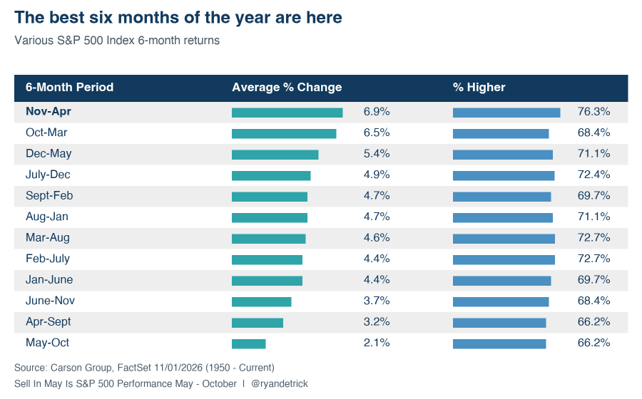
Election-related uncertainty is not the only historical pattern worth considering. U.S. equity markets have also demonstrated seasonal tendencies, with the November-through-April period historically producing stronger average performance than the May-through-October period. This seasonal pattern is sometimes discussed as part of the broader investment calendar, particularly when markets transition from the traditionally weaker six months of the year into a period that has historically delivered stronger returns.
When the transition coincides with the resolution of midterm election uncertainty, investors may encounter two historically favorable patterns at approximately the same time. That combination can contribute to a more constructive market outlook, particularly if corporate earnings and economic conditions remain supportive.
Nevertheless, seasonal trends should not be confused with reliable market-timing signals. Individual years can deviate substantially from historical averages, and unexpected developments can overwhelm even well-established statistical patterns. Economic recessions, inflation surprises, central bank decisions, and geopolitical events do not follow a predictable seasonal calendar.
For investors, recognizing these patterns means understanding the broader historical context rather than trying to exploit short-term fluctuations through frequent portfolio changes.
Why Political Headlines Can Lead to Poor Investment Decisions
One of the greatest challenges investors face during election cycles is separating political convictions from investment decisions. Strong opinions about political leadership can influence expectations about economic growth, taxation, regulation, and financial market performance. Those expectations may feel reasonable, particularly when reinforced by daily news coverage and commentary.
However, financial markets reflect a complex combination of expectations about future earnings, interest rates, economic activity, and investor sentiment. Political developments represent only one component of that equation. Even policies that appear unfavorable to certain industries may already be reflected in market prices, while unexpected economic improvements can offset concerns about the political environment.
Investors who make significant portfolio changes based primarily on election predictions risk being wrong twice. They may incorrectly anticipate the political outcome, or they may correctly predict the result but misunderstand how financial markets will respond.
This is particularly relevant for Canadian investors with meaningful exposure to U.S. equities. American political developments can influence currency movements, cross-border trade, sector performance, and broader portfolio valuations. However, investors should evaluate those considerations within a comprehensive investment framework rather than treating them as isolated reasons to abandon a long-term strategy.
A Disciplined Investment Strategy Matters More Than Election Predictions
Periods of political uncertainty provide an opportunity to review whether an investment portfolio remains aligned with its intended purpose. Rather than reacting to individual headlines, investors can focus on the underlying characteristics that determine whether their financial strategy remains appropriate.
That review should consider the relationship between portfolio risk and investment objectives, the degree of diversification across asset classes and geographic markets, and whether recent market movements have created unintended concentrations. It should also account for liquidity requirements, income needs, tax considerations, and the investor’s broader financial circumstances.
For Canadian investors, portfolio decisions may involve additional considerations related to U.S.-dollar exposure, registered and nonregistered accounts, and the tax implications of realizing investment gains or losses. These factors can have a more direct and lasting impact on individual financial outcomes than the immediate market reaction to an election.
A disciplined investment process does not require investors to ignore political developments. Instead, it places those developments within a broader assessment of financial risk and opportunity. The objective is to maintain a strategy that can adapt to changing conditions without letting short-term uncertainty dictate long-term decisions.
The Real Opportunity Is Maintaining Perspective
The historical relationship between midterm elections and financial markets reminds us that uncertainty and investment opportunity often coexist. Political headlines may dominate public attention, but markets ultimately respond to a much broader set of economic and financial influences.
History suggests that resolving election uncertainty has often been followed by favorable equity performance, regardless of which political party emerges stronger. That does not eliminate the possibility of future market declines, nor does it guarantee that historical patterns will repeat. It does, however, reinforce the importance of avoiding emotional investment decisions based on political expectations alone.
For investors, the most valuable response to an uncertain political environment is often to remain focused on the fundamentals: financial objectives, portfolio diversification, risk management, and the discipline required to navigate changing market conditions.
An election’s outcome may shape the political landscape for years. A strong long-term investment strategy should not depend on correctly predicting it.